Posts mit dem Label dressage werden angezeigt. Alle Posts anzeigen

Donnerstag, 7. Juni 2012

Karoline Valenta and Fabian at the 2012 European Junior and Young Riders Championships in Berne

After the 2012 CDI Achleiten last weekend as final selection opportunity the Austrian Equestrian Federation announced the teams that will represent Austria at the 2012 European Junior and Young Riders Championships in Berne, Switzerland, on 11 - 15 July 2012.

The Austrian Junior Riders' Team includes:

  • Katharina Haas - Wilsberg (by World Magic x Weinberg)
  • Lisa Maria Kerbler - Donna Rivera (by Rivero II x Horizon)
  • Kristina Sober -  Perfect Illusion SJP (by Pierot x Mytens)
  • Oliver Valenta - Rivel (by Rivero II x Polarstern)

The Austrian Young Riders' team is constituted by:

  • Franziska Fries - Alassio's Boy (by Alassio x Heraldik xx)
  • Lea-Elisabeth Pointinger - Gino (by Gardez x Adlerfarm)
  • Tatjana Svehla - Donaublick (by  Don Vino x Brentano II)
  • Karoline Valenta - Fabian (by Fabrian x Goldstern)

Freitag, 1. April 2011

FEDERATION FRANÇAISE DU LIPIZZAN

http://www.lipizzan.fr
La FFL regroupe les éleveurs, propriétaires, cavaliers, et utilisateurs réguliers du Cheval Lipizzan, exerçant leur activité à titre personnel, en association ou en société sur le territoire national français, désireux de contribuer au développement de la race, à la circulation de l’information dans tous les domaines, et d’entreprendre bénévolement toutes les actions nécessaires pour promouvoir l’élevage et la réputation du cheval Lipizzan de race pure.

Donnerstag, 10. Februar 2011

Manolo Mendez Article

Below is a link to a well written Manolo Mendez article articulating his position why a horse should be ridden in a supple and tension free way. He articulates his case from a biomechanical viewpoint using non-technical terms and illustrative examples to tie classical principals to biomechanics. He also provides general training tips, an exercise to assess balance and suppleness and discusses what he looks for in the way horses travel and carry themselves in determining the quality of the work.

The article does a good job balancing removing jargon while still having substance.

http://issuu.com/toplineinkpress/docs/toplineink_the_back_manolomendezfinal1

Freitag, 28. Januar 2011

The Secret of the Dressage-Letters


"Why are the dressage-letters placed the way they are?"


This question caught my curiosity many for many years. In this article I would like to share some of the findings of my research as well as stating my hypothesis as to why the letters might have found today's placing.
In his writings, Pluvinel (1652) states that the length of the tournament arena for horses with faster speed should be '100 Gang long and 30 Gang to slow down' (one "Gang" is the old version for one step). The width of the arena was not specified but the arena could also have had a square circumference. 
As found in the writings by Loehneysen (1609) the lenght of the arena was 200 shoe. The Roman City shoe "Palma Romana-12" was used as measure. This would give us an approximate length of 61 meters for the arena. If we hold that a horse's step is equal to the length of two human shoes, the length of the arena has almost remained the same over the past centuries (the Winter-Riding-School in Vienna is 58 x 18 meters). Yet in accordance with the type of tournament the length of the arena could be changed; the "Billia" had a lenght of 250 shoe.
The placement of the letters can be found in Loehneysen's "Della Cavalleria" (1609) yet not specific explanation was given.
The placement was as follows:

                A

F                                K


B                                E


M                                H

                  C


In centuries past the training of the horse was considered the only reason for Dressage and the letters were markers for specific exercises. Entering the arena by riding a half volte occurred at point "A" or, depending on the placement of the tournament arena at point "E" (Entrata).
The instruction say: "In this ring you should enter at point A if possible, at the first ring letter B ride two full circles on the right hand (right rein), at the third circle at the letter B turn left and continue on the left hand (left rein). In the pictorial instructions two rings (circles) were drawn at the letter B (figure of eight). 
One writing states that the "Judicierer" - the judge - has to be placed on the left side of the track (Correia). This could be the reason why the salut to the judge is executed in the center of the arena, later to be known as "X".
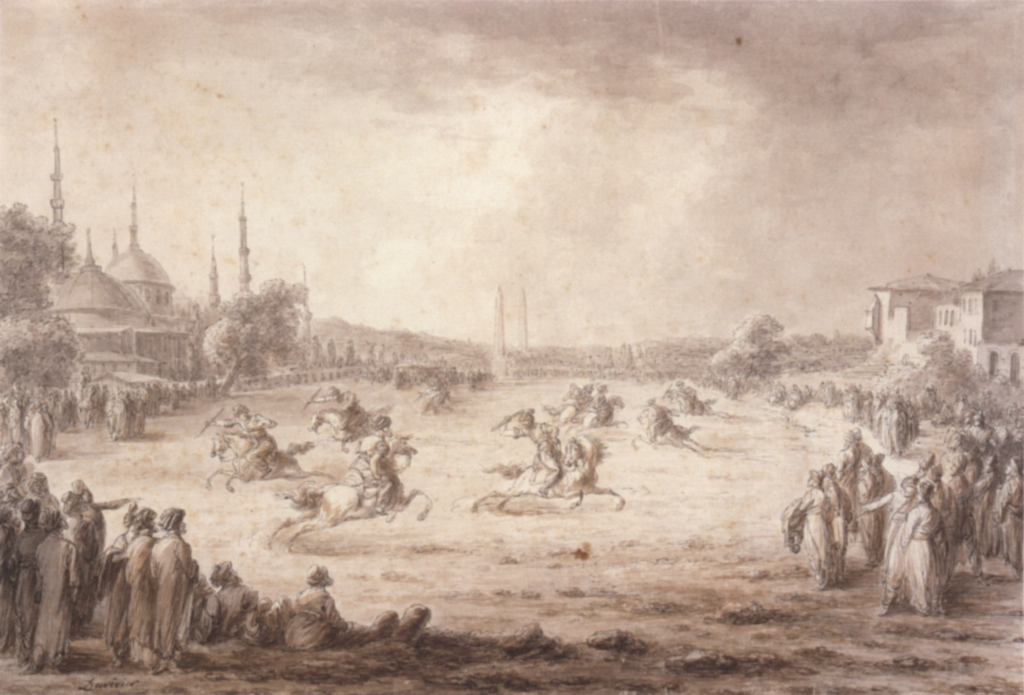
On February 5, 1662, under the management of Domenico Cheninis, better known as "la Vigna", a tournament called the "Head Race" was held on Burgplatz in Vienna. The accurate description of this race can be found under Cod. 10789H.S. in the collection of handwritings in the Nationalbibliothek (National Library) in Vienna. Different figureheads had to be charged, targeted and struck with the lance, the spear, the pistol and the epee. This Head Race was formed from a long standing tradition, developed from tournaments in the late 16th century.
Heads used besides the "Moor" and "Turk" heads were:
Centauro      (half human - half horse)
Tigra            (tiger)
Lione           (lion)
Dragone       (dragon)
Grifone        (bird of prey)
Crocodrilo    (crocodile)
Murione       (helmet)
Serpe          (snake)
Fochoa        (seal)

The addition of new heads called for new descriptions and letters.
The heads were allowed to have the same starting letter, for instance 'M' for Murione, Medusa or Moor head.
François Robichon de la Guérinière (1751) described the Head Race and the used figure heads in section 5, chapter 22 of his book "Reitkunst" (german, 1817, third edition) under the heading "Carussels".
Prompted by the wars against the Ottomans, these exercises were used by the Germans before the French.
In properly organized tournaments four heads made of paper-mâché were used. The first head had to be removed by the use of the lance. This head was either hung on something resembling a light post mounted to the wall or stuck on a post on the track. The second head was the flat head of Medusa, the third a Moor. The fourth was the one to be removed with the epee.
Strict rules had to be followed during the tournament such as: 
One was not allowed to be on the wrong lead, drop one's helmet or lose a stirrup. If one or more of these rules were broken the person lost the tournament even if all four heads were removed in the appropriate manner.

In conclusion I would like to raise the hypothesis that placement of today's dressage letters is based upon the tradition of head races and the closely related jousting from centuries ago.
Looking at modern dressage tests, depending on the level, we use as many as 17 letters as points of reference (A, B, C, D, E, F, G, H, I, K, L, M, P, R, S, V (U) and X).
Combining all the information so far presented with the traditional description of the figure heads, the letters A, B, C, D, E, F, G, H, I, K, L, M, S, can be explained. The letter H was already used in Loehneysen's  "Delle Cavalleria", the use of the letter X as description for the center-point of the arena appears obvious. The letter K could be the new version of script for the letter C at the end of the 19th century. The letters P, R and V (U) are still in need to plausible explanation. 

by Dr. Diether Polheim

Donnerstag, 19. August 2010

Great Story about Lippizaner Cross

who became one of Switzerland's most successful dressage horses and a two time Olympian. Not to mention his rider was the youngest rider ever at that time and first woman to make the Swiss Dressage team.

"....So their first Olympic experience ended with a team silver medal. Funnily in Tokyo in 1964 only one medal for every team was provided and gentlemen as they were Fischer and Chammartin handed this medal to Marianne." Now that is chivalry;-)

http://www.eurodressage.com/equestrian/2010/08/18/stephan-field-accident-gone-olympic

Source:www.eurodressage.com "Stephan, A Field Accident Gone Olympic"


Dienstag, 27. Oktober 2009

Necks, Lies and Video Tape---Rollkur continued.

Necks, Lies and Video Tape


By: Julie Taylor and Luise Thomsen

Epona TV

EDITORIAL: Right now, the world is rising up against rollkur, because a lolling, blue tongue got caught on video in Denmark. Ban it, is the message to the FEI. But how can something be banned, when it hasn’t been defined? And why should it be banned, when no adverse long term effects have been documented? Is hyperflexion even the problem?

What if I taught my horse – using treats or carefully timed pressure and release – to bend its neck extremely for a brief moment? That would be hyperflexion. But would it be evil? Should it be banned?

We propose that hyperflexion is not the biggest problem. Not where the welfare of horses is concerned. In terms of good dressage, there is little doubt that a short neck will detract from the quality of movement. But it in itself may not necessarily constitute abuse.

What is abusive is the way this hyperflexion is achieved and perpetuated through prolonged periods of time by insensitive and relentless pressure from the bit and spurs. The proponents of the technique will tell you that they never pull or force the horse into the frame and that they only ask it to stay there for brief spells at a time. This is a lie. The reins are used to pull - sometimes from side to side – on the horse’s mouth until it assumes the hyperflexed position. Then some of the pressure is sometimes released, although the reins remain short. If the horse tries to stretch its neck, it is harshly corrected by means of the curb and the spurs. We have seen this over and over and captured it on film. Horses go in the hyperflexed position – not for a few moments as officially claimed - but for several minutes at a time. Anky van Grunsven admits that she herself has not actually "a clue" how long these "brief spells" are. She doesn’t know. She thinks perhaps it’s less than fifteen minutes, although she isn’t sure. As Anky says: "Time flies when you’re having fun." We have this on film.

http://www.youtube.com/watch?v=svOBsSdjUvU

It is unthinkable that the FEI is not aware that hyperflexion of the neck is obtained by insensitive use of the bits. It is unthinkable that the FEI does not know that horses are subjected to several minutes of rollkur at a time. But still, the federation states that the technique is allowable "when used by professionals", because officially, spells of hyperflexion last no longer than 20 seconds (Sjef Janssen, Rollkur workshop Lausanne, 2006).

It is a bit of a pickle for the FEI. To ban hyperflexion of the neck, the FEI would have to not only admit that its most prolific trainer told a big, fat lie to the delegates of the 2006 workshop. A ban would also be the same as a confession to years of systematic animal cruelty on an unbelievable scale. And to a complete failure of the FEI to live up to its own Code of Conduct, which states that the welfare of the horse must be paramount at all times.

On the other hand, to ignore and allow the not so spectator friendly aspects of the sport is an invitation to animal rights groups to come and join the party. Having secured a third place in the freestyle in Odense, a grinning Patrik Kittel posed with Anky van Grunsven and Edward Gal in mink coats from a fur-factory which sponsored the show. There’s a lovely photo of the three of them looking very happy and completely oblivious to how they couldn’t really possibly – even if they tried – constitute a redder rag in the face of animal lovers everywhere.

So what can be done? Where is the FEI to turn? It would seem there is no way out of this for the sport of dressage. The FEI is damned if it does and it’s damned if it doesn’t. Except that, happily, it is now possible to measure rein tension electronically and thus introduce objective scores for lightness and submission. By introducing electronic rein tensiometry in all FEI sports, the federation can kill two birds (and hopefully, no more horses) with one stone. There will be no need to ban hyperflexion and tread on anyone’s toes. And nobody will ever win a ribbon on a horse which has been drilled through several hours of rollkur, habituating its mouth to relentless pressure and making it nearly impossible to halt.

Politically, this is the best thing that could happen to the FEI, although they probably don’t know it yet. The federation is caught between demanding superstars who rule the roost and the imminent threat of PETA picking up the phone and telling Rolex they have three and a half minutes to get the Hell out of horsesport before the poop hits the fan.

In doubt as to whether rein tensiometry is enough? Australian researchers have identified a method to use telemetric (wireless) accelerometry to chart the horse’s rhythm, straightness and stride length. They can even measure the nasal plane, making it impossible for judges to overlook when a horse is behind the vertical. We are not suggesting that we replace judges with robots, tempting as the notion might appear at this time. But by having objective measures for all to see, takes the pressure off the judges to do what they do best: Appraise the artistic value of the ride. At the same time, riders will be forced to prepare their horses correctly and sympathetically, as it is not possible to coerce a horse to comply with the FEI rules for dressage. Go and read the rules on www.fei.org - they constitute a small literary miracle. First authored in 1921 – that’s before Disney – it is a work of such compassionate, patient and insightful horsemanship as to never be paralleled before or since. If dressage is abusive, it’s because the FEI is not enforcing these rules.

It is understandable that the video clip of Watermill Scandic has caused grief and outrage in the horse loving community. The zombie-like resignation with which the stallion accepts the pain of whatever makes his tongue loll out. The seeming indifference of the rider, who doesn’t even give his horse a break upon noticing the problem. The fact that the Chief Steward didn’t think it pertinent to act. And the knowledge that this is the way to ride today, if one has any hope of making it to stardom. But this is not dressage. This is an imitation of dressage. Perhaps only sporadic fits of true dressage have ever existed through history – we may stand on the brink of a new golden age. If you want to make a change, don’t accuse, don’t despair, don’t look back. If you want to make a change, look forward – embrace the science and technology which alone can save equestrian sport from extinction. Unless you have a better idea.

Sonntag, 2. August 2009

Lis Hartel


Lis Hartel (March 14, 1921 – February 12, 2009) was a Danish equestrian athlete. Hartel became the first woman in equestrianism to win an Olympic medal when she won silver medals at the 1952 and 1956 Summer Olympics in dressage. She accomplished this feat despite being paralysed below the knees as a result of polio and required assistance on and off her horse. She has had a large impact on horsemanship in Denmark. She also was given a lot of credit for starting the movement for therapeutic riding schools, in fact one in Holland is named the Lis Hartel in honor of her.
The Danish Equestrian Federation announced that Hartel had died on February 12, 2009. She was 87.

Freitag, 17. Juli 2009

„Ich habe mich nicht an die Spitze gekauft“ (FAZ.net)

12. Juli 2009 Haya bint al Hussein, die 35 Jahre alte Tochter des verstorbenen Königs Hussein von Jordanien, führt die in die Krise geratene Internationale Reiterliche Vereinigung seit Mai 2005. Kraft ihres Amtes ist sie auch Mitglied des Internationalen Olympischen Komitees (IOC). Prinzessin Haya ist verheiratet mit dem Regenten von Dubai, Scheich Mohammed bin Rashid al Maktoum. Die Präsidentin des Weltverbands der Reiter spricht im F.A.Z.-Interview über Männer, Macht und blaue Briefe.

Sie haben vorige Woche in Aachen erklärt, Sie seien überzeugt davon, dass Isabell Werth trotz des positiven DopingTests bei ihrem Pferd unschuldig ist. Wie kommen Sie denn darauf?

Es stimmt, in ihrem Pferd war eine Doping-Substanz. Aber ihr Fall ist ganz typisch - für einen Reiter, der von seinem Tierarzt sehr schlecht beraten wurde. Ein Reiter kann nicht sein sportliches Niveau erreichen und gleichzeitig einen Hochschulabschluss in Medizin machen.

Damit argumentieren Sie gegen das eigene Regelwerk, das dem Reiter die ganze Verantwortung zuspricht. Wieso?

Ich weiß, ich sollte eigentlich keinen Kommentar zu ihrer Schuld oder Unschuld abgeben. Ich bin froh, dass ein unabhängiges Tribunal dafür zuständig ist. Was ich sage, wird dieses Gericht nicht beeinflussen. Aber auf menschlicher Ebene will ich sagen, dass sie eine sehr intelligente Person ist, die viel dafür geopfert hat, unseren Sport voranzubringen, eine wundervolle Karriere aufzubauen und dafür zu sorgen, dass die Fahne ihres Landes gehisst wird. Ich glaube nicht eine Sekunde, dass sie all das wegwerfen würde. Das ist unmöglich.

Sie wird aber wohl trotzdem wegen Dopings verurteilt werden.

Sie kann stolz sein, dass ihr Fall den Druck auf die FEI erhöht, Doping ganz oben auf die Agenda zu setzen. Es gibt nichts Wichtigeres, als sich diesem Feind zu stellen.

Und dazu taugen Ihre Regeln nicht?

Dieser Fall zeigt deutlich, dass die aktuellen Regeln total wirr sind, was die Rolle der Athleten angeht. Wir haben keine klare Unterscheidung zwischen Doping und Medikation. Überhaupt fehlt die Klarheit. Wir müssen die Regeln wirklich ändern.

Auch die Frage der Sanktionen ist unklar. Der Weltreiterverband FEI verhängt üblicherweise nur ein paar Monate Sperre. Jetzt schlägt die „FEI-Kommission für sauberen Sport“ vor, die in allen anderen Sportarten übliche Regelstrafe von zwei Jahren Sperre einzuführen. Wird das kommen?

Die Kommission für sauberen Sport, deren Vorsitzender Arne Ljungqvist ist, der Vizepräsident der Welt-Anti-Doping-Agentur, macht eine sehr wichtige Arbeit. Sicherlich hat uns auch die Frage der Strafen in die schwierige Situation gebracht, in der wir heute sind. Die Wirkung der Geldstrafen war gleich null. Und die der Sperren auch. Zusammen mit den Unklarheiten auf der Verbotsliste war unsere jetzige Situation unvermeidlich. Schon vor meiner Zeit wurde eine Task Force zum Thema Medikation gegründet, die versuchte, das Problem anzugehen, aber offensichtlich ging ihre Arbeit nicht tief genug. Ich denke, wir machen es uns zu einfach mit dem Versuch, dem Druck in den Medien zu entkommen, indem wir mit dem Finger auf Athleten zeigen und sagen: Sie müssen bestraft werden, und wir sind völlig unschuldig. Die Wahrheit ist, wir müssen die Verantwortung für die aktuelle Lage übernehmen. Wir waren nachlässig.

Wann werden die Strafmaße erhöht?

Wenn die Nationalverbände die Vorschläge der Ljungqvist-Kommission für gut befinden, werden sie in der nächsten Generalversammlung im November beschlossen. Dann würden sie im Januar nächsten Jahres in Kraft treten.

Der deutsche Verband ist der Überzeugung, dass die FEI ihm nicht besonders gewogen ist und Deutschland als Doper-Nation hinstellen will. Fühlen sich die deutschen Funktionäre zu Unrecht verfolgt?

Deutschland ist ein Riese in unserem Sport. Mit Riesen aber ist es so: Wenn etwas Gutes oder Schlechtes passiert, haben sie immer den größten Anteil daran. Gemessen an der Zahl der deutschen Reiter, ist es natürlich, dass das Problem zuerst hier ans Licht kommt und erst später im Rest der Welt. Doch das Doping-Problem gibt es überall.

Den größten Widerstand erfahren Sie durch die Europäer. Die führenden Reiternationen sagen, sie hätten das Vertrauen in Ihre Führung verloren. Wie konnte es dazu kommen?

Es gibt Presseberichte, in denen ich als eine Person hingestellt werde, die vom Arabischen Golf kommt, aus Dubai, und deshalb daran gewöhnt ist, Macht auszuüben. Als entscheidender Faktor wird benannt, dass ich mit einem der mächtigsten Männer der Welt verheiratet bin. In Wahrheit war einer der Hauptgründe, warum die Pferdesport-Gemeinschaft mich gewählt hat, dass ich in Europa aufgewachsen bin. Und dass ich meine Erziehung, was Pferde und Sport angeht, in Europa bekommen habe. Und dass ich ein sehr normales Leben geführt habe und mein Vater mich ermutigt hat, Schritt für Schritt meinen Weg im Pferdesport zu gehen. Ich habe mich nicht auf die Macht des Geldes verlassen und mich nicht an die Spitze gekauft.

In Ihrem Manifest, das Sie vor der Wahl 2005 verbreiten ließen, haben Sie im ersten Präsidentschaftsjahr zehn Millionen Schweizer Franken als Entwicklungshilfe versprochen. Ihre Kritiker werfen Ihnen vor, damit hätten Sie sich die Stimmen der kleinen Länder gesichert.

Europa macht es sich leicht, zu sagen, nur die kleinen Länder unterstützten mich. Aber Amerika ist kein kleines Entwicklungsland, und es gibt noch andere, die mich unterstützt haben und meinen Weg als den richtigen gesehen haben.

Womit erklären Sie sich dann den anhaltenden Gegenwind?

Wenn es Veränderungen gibt, bekommen die Leute Angst.

Unter den Hauptamtlichen in Lausanne sollen Angst und Schrecken herrschen. Unter anderem haben Sie bereits Ihren vierten Generalsekretär. Auch der Chefveterinär hat die FEI verlassen.

In meinem Manifest habe ich gesagt, wir müssen eine serviceorientierte Organisation werden. Das geht nicht mit Leuten, die strikt von neun bis fünf arbeiten und glauben, sie hätten ein Erbrecht, zu bleiben. Viele der europäischen Verbände erwarteten, dass ich alle Personalien mit ihnen diskutiere - wenn einer der Hauptamtlichen gehen musste, zurücktrat oder um Entlassung bat. Aber ich hätte das doch nicht mit 15 europäischen Ländern diskutieren können - und nicht mit dem Rest der Welt. Und die Leute haben ein Recht auf Diskretion. Die europäischen Länder hatten aber das Gefühl, sie hätten die Kontrolle verloren. Sie hatten sich viel zu sehr daran gewöhnt, dass sie alles kontrollierten. Eine sehr wichtige Aufgabe sehe ich darin, die Autorität des Weltverbandes wiederherzustellen.

Nun droht Europa mit einem eigenen Verband.

Die Europäer werden den Sport immer dominieren. Ich muss ihnen vielleicht deutlicher machen, dass ich davon überzeugt bin. Seit 15 Jahren diskutieren die europäischen Föderationen darüber, einen eigenen Verband zu gründen, das Problem habe ich nicht verursacht. Ich fände es aber furchtbar, wenn es passieren würde. Es wäre sehr kurzsichtig von den Europäern, jetzt unsere Familie zu spalten, weil sie mit mir persönliche Probleme haben.

Werden Sie im nächsten Jahr für vier weitere Jahre kandidieren?

Ja. Danach sind sie mich los.

Die Auseinandersetzung mit Europa ist viel aggressiver geworden, seit der FEI-Vorstand versucht hat, sein eigenes Mitglied, den Deutschen Hanfried Haring, zu suspendieren. Begründung war, er sei Mitwisser im Medikationsfall von Marco Kutscher gewesen und habe die FEI nicht informiert. Haring ist Vorsitzender einer der beiden europäischen Ländergruppen, weshalb es hieß, Sie wollten vor allem einen unbequemen Kritiker kaltstellen. Bereuen Sie diesen Schritt?

Nein. Über dem Kopf eines unserer Vorstandsmitglieder schwebte ein Fragezeichen, weil er in einen laufenden Fall verwickelt ist. Er ist schließlich an Entscheidungsprozessen beteiligt, in denen es auch um unser Engagement für den sauberen Sport geht. Ziel war es nicht, ihn für schuldig oder unschuldig zu erklären. Wir wollten ihn nur bitten, sich zurückzuziehen, bis der Fall geklärt sein würde. So etwas passiert in jeder normalen Organisation der Welt. Es war nicht persönlich gemeint.

Er nahm es aber persönlich. Zumal Ihr Versuch am FEI-Sportgericht scheiterte.

Ich habe nicht mit ihm darüber gesprochen. Aber wir im Vorstand sind uns einig, dass wir uns der Entscheidung fügen und ihn weiterhin wie ein Vorstandsmitglied behandeln werden. Wir werden sehen, was die Untersuchung erbringt. Ich hoffe, dass unser Sportgericht in Zukunft mutig genug sein wird, zu sehen, dass niemand über dem Gesetz steht. Auch innerhalb des Verbandes. Das ist ein neuer Weg für die FEI, aber darum geht es bei den Themen Good Governance und Transparenz.

Da kommt man automatisch auf den Doping-Fall Ihres Ehemannes, dessen Di-stanzpferd positiv auf Testosteron und das Psychopharmakon Guanabenz getestet wurde. Was ist denn da der Unterschied zu Harings Rolle im Fall Marco Kutscher? Warum haben Sie sich nicht selbst suspendieren lassen bis zur Klärung, sondern lediglich erklärt, sich herauszuhalten zu wollen?

Ich wusste nichts von seinem Doping-Fall, und unglücklicherweise wusste er auch nichts davon. Das ist der wichtigste Punkt: Nach unseren Regeln ist die verantwortliche Person für einen Doping-Fall der Reiter. In den Vereinigten Arabischen Emiraten und anderen Ländern, wo das Distanzreiten verbreitet ist, wird so viel Geld investiert, dass dieser Sport explosionsartig gewachsen ist. Die Reiter sind nicht durch die normale Schule gegangen, wie der Rest unseres Sports sie durchgemacht hat. Darum hat das Distanzreiten sich in eine Richtung entwickelt, wo Besitzer Hunderte von Pferden haben können, mit deren Training sie nichts zu tun haben. Sie können am Tag des Wettkampfs aufkreuzen und wissen manchmal nicht einmal, welche Farbe das Pferd hat, mit dem sie starten werden. Das ist falsch, und ich hoffe, dass die Leute am Fall meines Mannes erkennen, dass sie ihre Verantwortung akzeptieren müssen und alles über die Vorbereitung ihres Pferdes wissen müssen, bevor sie aufsteigen und losreiten. Ich verstehe, dass es aussieht, als wäre ich als Präsidentin wegen dieses Falles angreifbar. Solange meine Familie Wettkämpfe bestreitet, wird das eine Schwäche bleiben. Ich habe immer gefürchtet, dass so etwas passieren würde.

Und doch ist er Ihr Mann und nicht nur Mitglied Ihres Verbandes wie im Fall Kutscher und Haring.

Ich sehe mich in diesem Fall nicht in der Verantwortung. Ich wäre sehr stolz, wenn die FEI ihn behandeln würde, wie es sich gehört, und er würde das genauso sehen. Es sollte keine Sonderrolle für ihn geben.

Es heißt ja immer, Sie wollten Distanzreiten ins olympische Programm bringen, um Ihrem Mann einen Gefallen zu tun. Wie weit sind Sie damit?

Lassen Sie mich klar sagen, dass ich kein Szenario sehe, in dem Distanzreiten olympisch werden kann. Ich bemühe mich auch nicht darum. Ich glaube nicht, dass diese Disziplin genug Struktur hat, und denke, dass noch viel Arbeit nötig ist, damit sie ein vollwertiges Mitglied der Sportfamilie wird. Kommerziell ist sie noch kein erfolgreiches Produkt. Wir haben Diskussionen über das Wohl der Pferde, wir haben erhebliche Doping-Probleme. Ein Kriterium des IOC ist außerdem die Historie eines Sports. Dieser Sport ist siebzehn oder neunzehn Jahre alt - da kann er nicht in Konkurrenz mit Springen oder Dressur treten. Auch nicht mit Voltigieren, was mehr Chancen hätte, wenn wir es versuchen würden.

Das dürfte den Wünschen Ihres Mannes nicht entsprechen.

Mein Vater vermittelte mir ein Leben mit Pferden. Und das war, wie ich hoffe, einer der Gründe, warum mein Mann mich geheiratet hat. Aber nicht, um meine Rolle in diesem Sport auszunutzen. Wir versuchen beide nicht, Distanzreiten ins olympische Programm zu drücken.

Sie haben aber vor einiger Zeit einer englischen Fachzeitschrift ein Interview gegeben, in dem sie vor allem Dressur und Vielseitigkeit harsch kritisieren und ihr Verbleiben bei Olympia in Frage stellen. Wieso?

Wenn es ernsthafte Probleme gibt, muss ich sie benennen, vor allem, wenn unsere Mitglieder versuchen, sie einfach auszusitzen. Unsere Beziehungen zum Internationalen Olympischen Komitee hängen nicht mehr von Einzelpersonen ab. Mittlerweile arbeitet das IOC mit Zahlen und Fakten. Zuschauerzahlen, Übertragungszeiten und Einschaltquoten, Verbreitung, Todesfälle im Sport, Doping-Fälle. Ich habe eine Warnung vom IOC bekommen, dass wir in der Vielseitigkeit die Sicherheit verbessern müssen. Und in der Dressur wurden wir gewarnt, dass das Richtersystem intransparent ist. Es gab deshalb Kritik in Hongkong. Wir hatten das Problem im Vorstand schon zwei Jahre vorher angesprochen, aber es ging einfach immer so weiter, die technischen Komitees reagierten nicht. Als es so schlimm wurde, dass ich die Briefe vom IOC bekam, musste ich handeln.

In der Dressur haben Sie bei der letzten Generalversammlung das ganze Komitee zum Rücktritt veranlasst.

So sind wir dem Problem begegnet. Ich freue mich auf die Arbeit, die die Task Force leisten wird. Die konkreten Ergebnisse werden das IOC zufriedenstellen. Und auch in der Vielseitigkeit werden wir das Problem angehen.

Wer hat diese Briefe geschrieben? Die Programmkommission des IOC?

Die Briefe waren von Präsident Rogge persönlich unterschrieben.

Das Gespräch führte Evi Simeoni.

Samstag, 13. Juni 2009

Dressurfestival Aubenhausen

Start:     Jun 26, '09
End:     Jun 28, '09
Location:     Familie Werndl - Reitanlage Aubenhausen
Seit mehr als einem Jahrzehnt ist das Aubenhausen Dressurfestival ein Höhepunkt im Dressursport. Das prominente Starterfeld, das besondere Ambiente, der professionelle Service und das attraktive Rahmenprogramm machen dieses Dressurturnier jedes Jahr zu einem Publikumsmagneten.

Das Aubenhausen Dressurfestival bietet wieder eine große Bandbreite an Dressur-Prüfungen mit vielen bekannten Namen und Gesichtern aus dem Reitsport. Erleben Sie den Dressursport von seiner schönsten Seite und seien Sie gespannt auf ein Wochenende voller Eleganz, Natur, netten Menschen und guter Gespräche.

http://www.aubenhausen.de